Français
 English
 Español
 Українська
 Deutsch
 简体中文
简体中文 Italiano
 日本語
日本語 العربية
 हिंदी
हिंदी Português
 বাংলা
বাংলা ภาษาไทย
 Tiếng Việt
 한국어
한국어 Русский
Why this activity is fascinating

The most important point for me in our jobs is to be passionate. To do what we love. ... Read

 670
670

Agile methodology refers to a way of designing and evolving a project through short stages, with regular adjustments. Popularized from 2001 onward by the Manifesto for Agile Software Development, it contrasts with overly rigid approaches by prioritizing adaptation, collaboration, and the rapid delivery of concrete results.
Applied to software development, this philosophy has deeply influenced the practices of technical teams, but also, more broadly, the organization of work in many digital projects.
To begin, here is the Agile Manifesto, a foundational text written by seventeen software experts. It has had a major impact on organizations and the software community.
Agile development consists of moving a project forward through successive stages rather than following a fixed process from beginning to end. Each iteration makes it possible to produce a concrete result, test it, correct it, and gradually enrich the product.
This approach reduces the gaps between what was initially imagined and what is truly useful once the project is underway. It also provides better visibility into progress, since the work is assessed based on usable results rather than documents or theoretical plans.
In practice, agile development involves frequent exchanges, regularly reassessed priorities, and the ability to incorporate changes without completely disrupting the project.
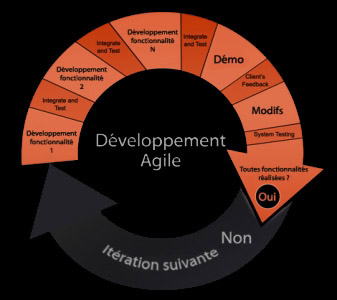
Agile methods do not refer to a single framework, but to a family of approaches that share the same principles. They all emphasize collaboration, continuous improvement, breaking work into small steps, and adaptability.
Among the best-known methods, Scrum structures work into short cycles with clear objectives and regular discussion times. eXtreme Programming places greater emphasis on development practices, code quality, and the ability to deliver frequently.
These frameworks do not replace reflection on needs or team organization, but they provide a more flexible and concrete way of working than traditional approaches when the project evolves quickly.
Today, agile methods are used in many organizations, especially in digital projects. They make it possible to better manage uncertainty, shorten decision-making cycles, and bring technical teams closer to real needs.
Their success also comes from the fact that they are not limited to a production method. They influence how people collaborate, prioritize, listen to users, and evolve a project without waiting until the end to measure its value.
Adopting an agile approach therefore does not simply mean following a framework such as Scrum. Above all, it means accepting that a project evolves, that needs change, and that effectiveness depends as much on human organization as on the tools used.
The most important point for me in our jobs is to be passionate. To do what we love. ... Read
670

Discover Getting Things Done, a simple method to get organized, manage tasks and boost productivity without feeling overwhelmed. ... Read
1 451
 Get oOur best articles